Parallel parking means reversing into a space between two cars, finishing straight and close to the kerb. The secret is knowing where to look at each step. At Bear County Driving School, we break it into four stages with simple reference points. Many pupils also use RouteBuddy Driving Test Routes to get to know the roads near their test centre.
Is Parallel Parking on the Driving Test?
Yes, it can be. You will do one reversing exercise, and parallel parking at the side of the road is one of the options. The others are parking in a bay and pulling up on the right. You can read more in the GOV.UK guide to the driving test.
Since you will not know which one you get, it pays to practise them all.
Parallel Parking in Four Steps, With Diagrams
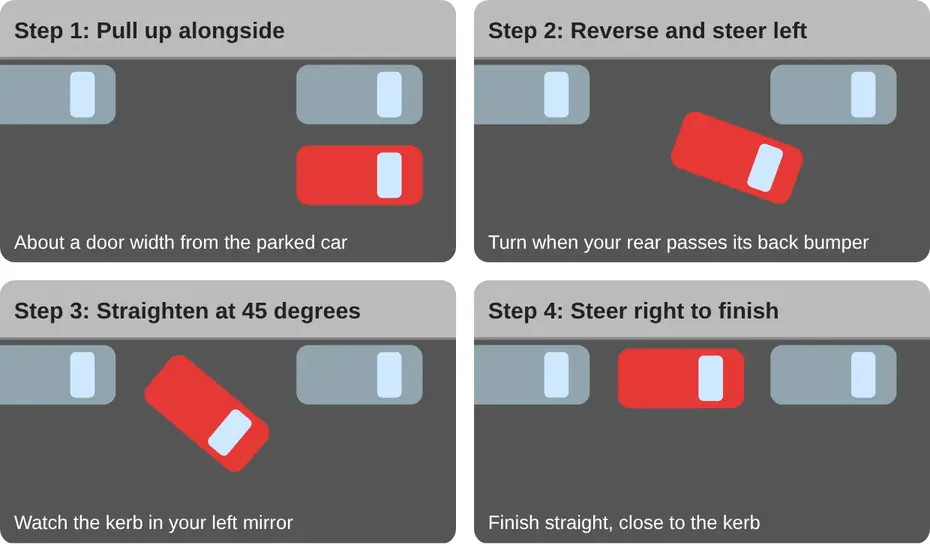
Step 1: Pull Up Alongside the Parked Car
First, stop next to the car in front of the space, about a door width away. Line up your rear bumper with theirs, roughly. After that, check all around and select reverse.
Step 2: Reverse and Steer Left
Creep back slowly. When your back wheels pass their rear bumper, steer left. Meanwhile, keep checking all around, as other traffic may come past.
Step 3: Straighten at About 45 Degrees
Watch the kerb in your left mirror. Once your car sits at about 45 degrees to the kerb, straighten the wheel. Then keep reversing slowly.
Step 4: Steer Right to Bring the Front In
When your front clears the other car, steer right. As a result, the front swings towards the kerb. Then straighten up and stop, close to the kerb and parallel to it.
Reference points change from car to car. So ask your instructor to set them for the car you will use on test day.
What Goes Wrong With Parallel Parking, and How to Fix It
| What happened | Likely cause | What to do |
|---|---|---|
| Too far from the kerb | Turned left too late | Steer a little earlier next time |
| Back wheel touches the kerb | Turned left too early, or too much | Stop, pull forward a little and correct |
| Front sticks out | Steered right too late | Watch for the front clearing the other car |
| Too close to the car behind | Reversed too far | Use the rear view to judge the gap |
In fact, a small correction is fine. Examiners care more about control and good observation than a perfect first attempt.
What Do Examiners Watch During Parallel Parking?
- Observation. Look all around before and during the move, not just in your mirrors.
- Control. Keep the car slow and smooth, using clutch control in a manual.
- Accuracy. Finish reasonably close to the kerb and parallel to it.
- Safety. Stop and wait if a pedestrian or car comes near.
Where to Practise Parallel Parking
At first, quiet residential roads are the best place to start. Then move on to busier streets once the steps feel natural.
It also helps to know the area around your test centre. If you test in Nuneaton, the Nuneaton driving test routes guide shows the local roads. Then practise on similar streets with your instructor.
Want to see your test area before your next lesson?
These buttons are for the RouteBuddy app. Get it on your phone and look over the roads around your test centre.


We teach learners across the area. See our pages on driving lessons in Nuneaton, lessons in Bedworth and Hinckley driving lessons. Next, read our guide to roundabout rules for learners.
Parallel Parking: Quick Answers for Learners
Can you fail the test for touching the kerb?
A light touch you correct calmly may only be a minor fault. However, mounting the kerb or hitting it hard is more likely to be marked as serious.
Can you correct your position?
Yes. Pulling forward a little to straighten up is fine, as long as you check all around first.
How close to the kerb should you finish?
In short, reasonably close and parallel to it. Your instructor can show you how that looks from the driver seat.
How long does it take to learn?
It varies. However, most learners get the hang of it after a few focused practice sessions.
The Bottom Line
Parallel parking feels hard because you cannot see everything at once. Learn where to look at each step, keep the car slow and check all around. With practice, it becomes one of the easiest parts of the test.